Your moussaka slides off the spoon
A moussaka fails because something in it was wet. That is the entire secret. There are four sources of water in the dish and the chapter removes each one in order.
Chapter 21
Yiayia Eleni · First Edition · MMXXVI
Eight methods, two hundred dishes, and the reason yours goes wrong.
Greek cooking is not a cuisine of complicated dishes. It is very few techniques applied to whatever the season gave you, with a great deal of olive oil and a great deal of patience. There are maybe eight methods in the whole tradition. Thirty-six chapters that teach the eight, so you can cook two hundred dishes without opening a book again.

The honest part
There are no photographs of blue doors in here and no talk of how the light falls on the sea. You can get that anywhere. What you cannot get easily is the reason your spanakopita went soggy, or why your lamb came out grey and tight when mine comes out falling off the bone, or how much lemon is the right amount of lemon. That is what I have written down.
Your moussaka slides off the spoon
A moussaka fails because something in it was wet. That is the entire secret. There are four sources of water in the dish and the chapter removes each one in order.
Chapter 21
Your avgolemono scrambles
The eggs are not going into the pot. The pot is going into the eggs, a little at a time, until they are no longer afraid of it. Three thousand times made, five times split.
Chapter 14
Your spanakopita has a puddle
One kilo of fresh spinach becomes about 250 grams of usable filling. If your filling weighs more than that, the water is going to end up in your pastry.
Chapter 25
Your tzatziki turns to soup by dinner
A large cucumber will give up something like half a cup of water. If you do not take it out now, it will come out in the bowl over the next two hours.
Chapter 28
Your lamb comes out grey and tight
The cheap cut is the right cut, and the method is a low flame and a lid you do not lift. Lifting it drops the temperature and adds a surprising amount to the total time.
Chapter 6
Everything you make tastes vaguely beige
Stock is not a Greek ingredient. It is a French one. Water is correct. I know it sounds wrong. It is not wrong.
Chapter 1
How every chapter is built
You do not have to read it in order, but I would ask you to read the first part before anything else. Five short chapters. They are the grammar. Everything after them is vocabulary, and vocabulary without grammar is how people end up with a kitchen full of ingredients and nothing worth eating.
And what usually goes wrong with it, said plainly, before any ingredient is mentioned.
Walked through the way I would walk you through it standing next to you, not read out as a list.
With quantities, in cups and in grams, where it earns its place on the page.
An honest note on the limits, or when to stop trying and buy the thing instead.
Contents
Meat and fire. The pot. The oil dishes. The baked dishes. Phyllo. The table. The sweets. The year. Tap a part to see its chapters.
Read a page
My father pressed his own oil until he was eighty-one. I grew up with the smell of it in the yard every November and I have never in my life measured it. So I want to be careful here, because the way Greeks use oil is genuinely different from the way most people use it, and the difference is not a small one.
Here is the shape of the problem. In most kitchens, oil is a lubricant. It exists to stop food sticking to the pan. You use as little as you can get away with, and if you could cook without it you would. In a Greek kitchen, oil is an ingredient. It is often the main ingredient. There is an entire category of our food, the ladera, whose name simply means the oily ones, where the oil is not helping the vegetables cook. The oil is the sauce.
A tray of green beans for four people takes about 120 millilitres of olive oil, which is half a cup. When I say that to visitors, they think I have misspoken. I have not. Without that much oil the beans steam, go khaki, and taste of nothing.
| Raw — salads, dips, finishing | Best oil you own |
|---|---|
| Ladera — vegetables braised in oil | Good oil, generous |
| Roasting — lamb, chicken, potatoes | Everyday oil |
…continues for four more pages, and thirty-four more chapters.
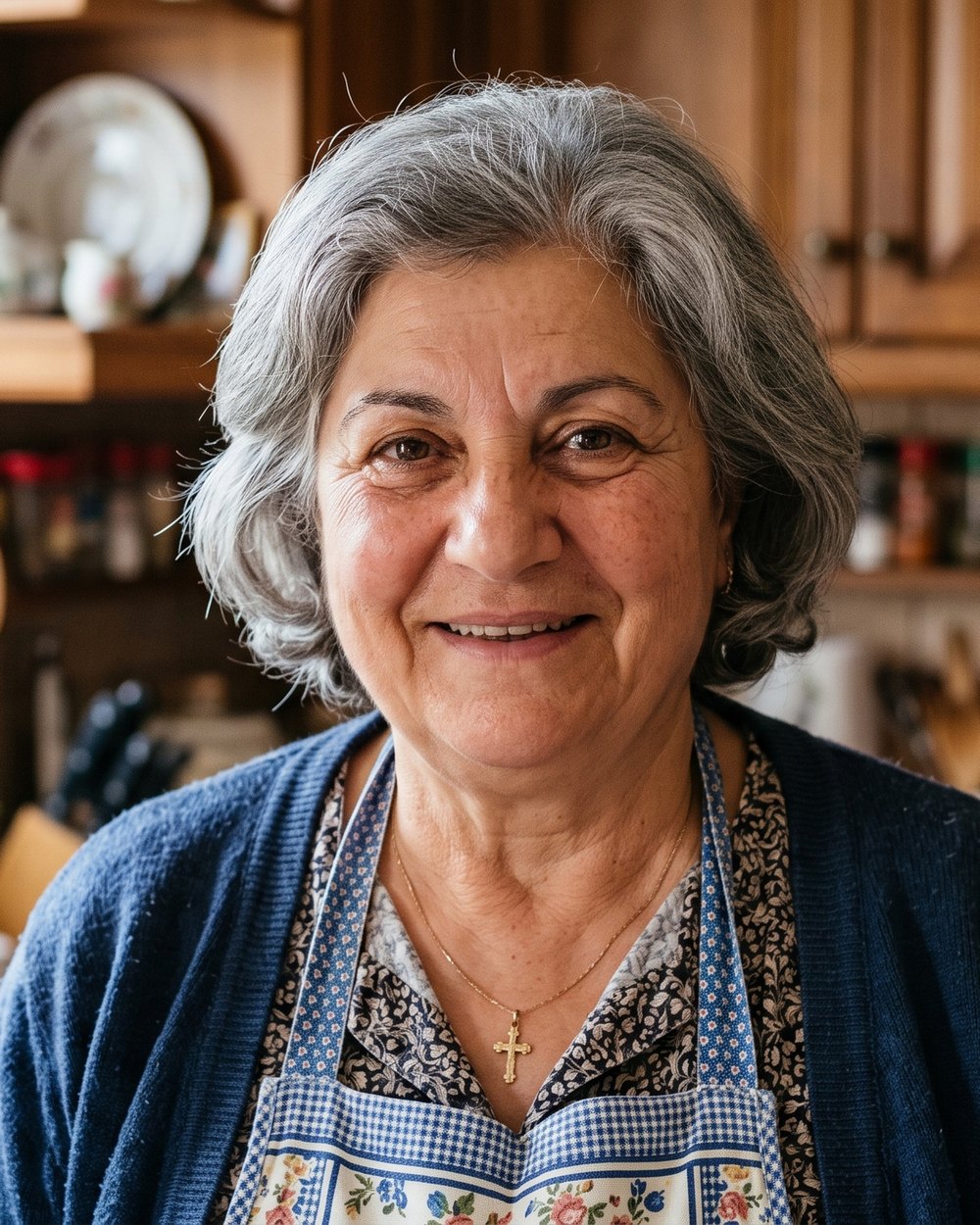
Eleni Stavrou, in the kitchen she has cooked in since 1983.
Who is writing
I was born in 1952 in a village above Kalamata, in Messinia, where my father had four hundred olive trees and my mother had a wood oven she fired twice a week.
I married a man from the north and spent eleven years in Epirus, in the mountains, where his mother Sofia taught me to roll phyllo by hand because in her house buying pastry was something you did not admit to. I came back south in 1983 and I have cooked in the same kitchen ever since.
Some of what is in this book has been on my channel. Most of it goes further than the videos do, because a video is eight minutes and a kitchen is a lifetime. Some of it has never been anywhere, because it is the kind of thing you only say to someone standing next to you at the counter.
Not that you cook my recipes forever,
but that you stop needing them.
Before you buy it
It will not give you photographs of every dish. It is a manual. The pictures in it are there when a picture explains something a sentence cannot.
It will not make Greek food fast. Some of it is fast. The best of it is a low flame and two hours, and no book can shorten that.
It will not rescue an ingredient that was wrong before it reached your kitchen. There is a note in nearly every chapter about when to stop trying and buy the thing instead.
It will not teach you a hundred and eighty recipes by rote. It teaches eight methods. The recipes are what falls out of them.
The digital first edition
Eight methods, two hundred dishes, and the reason yours goes wrong.
Secure checkout through Gumroad · instant access · 30-day refund, no argument
Questions I get asked
No. It is a PDF, delivered the moment you pay. That is deliberate — it means it costs $27 instead of $40, it reaches you in Australia as fast as it reaches my neighbour, and you can print the four pages you actually cook from and let them get oil on them.
Some of it has been on the channel. Most of it goes further than the videos do, because a video is eight minutes and a kitchen is a lifetime. And some of it has never been anywhere — the things you only say to someone standing next to you at the counter.
It is written for someone who can boil water and follow a sentence. The first five chapters are the grammar — heat, salt, time, oil, acid, herbs — and they are short. If you read those, the rest of the book explains itself.
The chapters people write to me about are the ones on avgolemono, on bechamel, on why moussaka slides, on the syrup rule that governs every Greek sweet, and on the twenty-five things about baklava. Those are not beginner chapters. They are the accumulation of small details that no single recipe has room for.
A great deal. An entire part — the ladera — is vegetables braised in olive oil, and it is what half of Greece eats for half the year because of the fasting calendar. There is a chapter on that calendar too, and on wild greens.
Yes. Thirty days, and you do not have to explain yourself to me. Write to Gumroad and it is done. I would rather you had the money than a book you did not want.
Twelve things, and a vegetable shop. Chapter 1 lists them in the order I would buy them starting from an empty cupboard. There is no stock, no cream, and almost no chilli on that list, and the chapter explains why for each.
“A video is eight minutes.
A kitchen is a lifetime.”
Eleni Stavrou · Messinia, Peloponnese · 2026
Get The Greek Kitchen Manual · $27136 pages · 36 chapters · instant PDF · lifetime updates